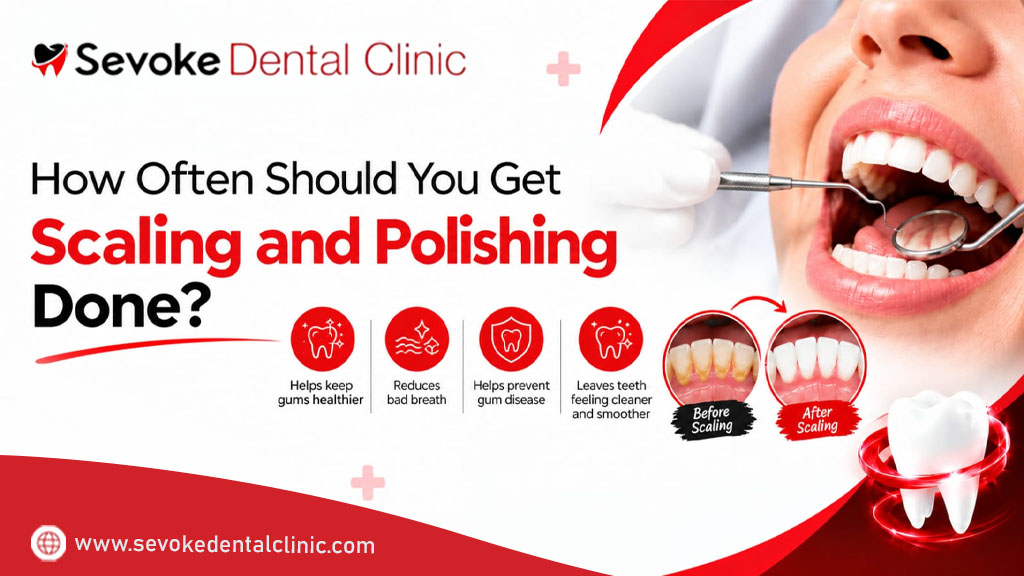
Short answer: most people should get scaling and polishing done every six months.
That’s the standard gap dentists recommend, and it works well for a healthy mouth. But it’s a starting point, not a rule carved in stone. Some people need a cleaning every three or four months. Others can stretch it a little.
Let’s work out which group you’re in.
First, What Is Scaling and Polishing?
Scaling is the part where your dentist removes plaque and tartar from your teeth and from just under the gum line. Tartar is a hardened plaque. It sticks to the tooth like cement, and no toothbrush can shift it.
Polishing comes next. The tooth surface is smoothed so stains lift off and plaque finds it harder to cling back on.
Put together, it’s what most people mean when they search for teeth cleaning in Siliguri. It’s a quick, routine procedure, and most people are done within an hour.
Why Every Six Months?
Plaque never takes a day off. It forms on your teeth within hours of brushing, and if it stays, it hardens into tartar over time.
A six-month gap is long enough to be practical and short enough to catch problems early. Tartar hasn’t built up too much. Gums haven’t had time to get seriously irritated. And your dentist gets a regular look at your whole mouth, not just the teeth that hurt.
That second part matters more than people think. A cleaning visit is also a check-up. Small cavities and early gum trouble are far easier to fix when they’re caught early.
Who Might Need It More Often?
Some mouths simply collect tartar faster. Your dentist may suggest a gap of three to four months if you:
- Have had gum disease before, or your gums bleed easily
- Smoke or use tobacco in any form
- Wear braces or clear aligners, since food and plaque get trapped around them
- Have diabetes, which can make gums more prone to infection
- Often have a dry mouth
- Notice tartar coming back quickly, even when you brush well
None of this means you’re doing something wrong. It just means your mouth needs a shorter schedule. A good dentist in Siliguri will tell you what suits you after looking at your gums, not by following a fixed script.
Signs You're Due (or Overdue)
Your mouth usually gives hints before you book. Watch for:
- Gums that bleed when you brush or floss
- Bad breath that doesn’t go away after brushing
- A rough, yellowish layer near the gum line
- Red, puffy or tender gums
- Stains that brushing doesn’t touch
If you’ve ticked more than one, don’t wait for the next six-month mark. Get it checked sooner.
What Happens If You Skip It?
Tartar can’t be brushed away at home. Once it’s there, it keeps collecting more plaque on top of it.
This causes irritation of the gums, which leads to gingivitis or the early form of gum infection. If not treated, this condition will progress to gum disease, where the supporting structure of the teeth including the gum tissue and the bone will be affected. This is often accompanied by bad breath as well.
The best thing about early gum disease is that it is reversible with just good oral hygiene practices and cleaning.
Does Scaling Damage Your Teeth?
This is one of the most common worries, so let’s clear it up.
When it is done correctly by the dentist, scaling will not harm your teeth’s enamel. Ultrasonic scalers work by sending mild vibrations and water spray on the teeth to remove any calculus build up.
Some people feel mild sensitivity for a day or two afterwards, especially if there was a lot of tartar. That usually settles on its own. If it doesn’t, tell your dentist.
Scaling and Teeth Whitening: Are They the Same?
Not quite, and this confuses a lot of people.
Scaling and polishing removes surface stains and build-up. Your teeth often look brighter afterwards, simply because the layer covering them is gone. But it doesn’t change the natural shade of your teeth.
Teeth whitening in Siliguri, or anywhere else, is a separate treatment that lightens the tooth colour itself. Dentists often recommend cleaning first, so whitening can work on a clean surface. If brighter teeth are your goal, mention it at your visit and your dentist can advise the right order.
What to Expect at Your Visit
At our dental clinic in Siliguri, a scaling and polishing visit is simple.
To begin with, your dentist will examine your teeth and gums. This will be followed by the process of scaling, mostly done using an ultrasonic scaler, after which comes the polishing stage.
You can eat and drink normally afterwards, though it’s sensible to go easy on very hot, cold or strongly coloured food for the first few hours if your teeth feel sensitive.
Keeping Your Teeth Clean Between Visits
Professional cleaning works best when your daily habits back it up.
- Brush twice a day with a soft-bristled brush for two minutes
- Clean between your teeth daily with floss or interdental brushes
- Brush or scrape your tongue gently
- Cut back on tobacco and sugary snacks
- Drink water through the day
Small habits, done consistently, are what keep tartar low between appointments.
Frequently Asked Questions
How often should I get scaling and polishing done?
Is scaling and polishing painful?
Can I get scaling done too often?
Does scaling make teeth looser?
Will teeth scaling make my teeth whiter?
Is scaling and polishing necessary if I brush every day?
Book Your Scaling and Polishing Visit
Sevoke Dental Clinic has been practicing dentistry in Siliguri, Sevoke Road, for more than 15 years, and teeth cleaning is one of the most common treatments performed here. Teeth cleaning has to be done after six months or when there is bleeding from gums.
📍 2nd Mile Sevoke Road, Opposite Hotel Sachitra, Siliguri
📞 97321 22883 | 98000 08511 | 98320 93030