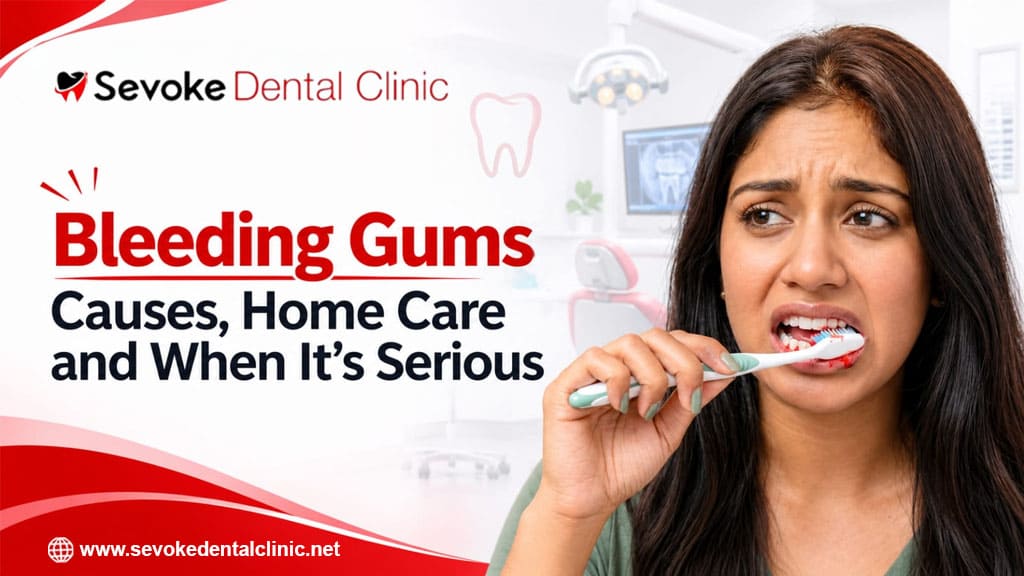
You spit after brushing and the sink has a pink tinge. You shrug, rinse it away and move on.
Most of us have done exactly that. Bleeding gums feel so ordinary that people assume they’re just part of brushing, especially if it only happens now and then.
They’re not. Healthy gums don’t bleed. So if yours do, even a little, your mouth is trying to tell you something. It’s usually fixable, and the earlier you listen, the easier it is.
Is it Normal for Gums to Bleed When You Brush?
Short answer: no. A bit of blood once in a while, say after a hard scrub, isn’t a disaster. But gums that bleed regularly are a sign of irritation or infection, and they deserve attention.
The good news is that the most common cause is also the most fixable one.
What Causes Bleeding Gums?
The usual culprit is plaque. That’s the soft, sticky film that builds up on your teeth every day. If it isn’t cleaned off properly, it irritates the gum line, and the gums swell up and bleed easily. Dentists call this early stage gingivitis.
Leave plaque there long enough and it hardens into tartar, which no toothbrush can remove. Tartar keeps the irritation going, and the gums keep bleeding.
But plaque isn’t the only reason. A few others come up often:
- Brushing too hard, or using a stiff-bristled brush
- Starting to floss again after a long break (more on that below)
- Smoking, or chewing gutka, khaini and paan with tobacco
- Hormonal changes, such as during pregnancy
- Certain medicines, including blood thinners
- Poor nutrition, particularly a lack of vitamin C
- Braces, or dentures and fillings that don’t fit well
- Some health conditions, such as diabetes or blood disorders
So if you’ve been brushing carefully and your gums still bleed, don’t just brush harder. The cause may be somewhere else.
Why Do Gums Bleed When You Start Flossing?
This one catches people out. You decide to be good, you floss for the first time in months, and your gums bleed.
Usually that doesn’t mean flossing is hurting you. It means the plaque between your teeth had been sitting there, and the gums around it were already inflamed. Keep flossing gently every day, and the bleeding often settles within a week or two as the gums get healthier.
If it doesn’t settle, that’s your cue to see a dentist.
When Do Bleeding Gums Turn into Gum Disease?
Think of gingivitis as a warning light. Your gums are red, puffy and bleed easily, but the bone holding your teeth is still fine. At this stage a professional clean and better home care can turn things around.
If it’s ignored, it can move on to periodontitis. That’s when the infection spreads below the gum line, the gums start pulling away from the teeth, and the bone around them can break down. Teeth can become loose. This stage is harder to treat, and some of the damage can’t be reversed.
What makes gum disease sneaky is that it often doesn’t hurt in the early days. Plenty of people only find out when a tooth starts to wobble. Bleeding is frequently the first thing you’ll notice, so it’s worth taking seriously.
What Can You Do at Home?
If your gums bleed now and then and nothing else seems wrong, these simple habits help:
- Brush twice a day with a soft toothbrush. Angle it toward the gum line and use gentle circles, not a hard back-and-forth scrub.
- Floss once a day, even if it bleeds at first.
- Rinse with warm salt water. It’s a soothing, cheap rinse that can calm sore gums.
- Drink water throughout the day and eat plenty of fruit and vegetables.
- Cut down on tobacco, because it makes gum problems worse.
One thing to avoid: don’t stop brushing the bleeding area because it feels tender. Skipping it lets more plaque build up, and the bleeding usually gets worse.
Home care is a good first step, but it has limits. It can’t remove tartar. If you’ve done all this for a couple of weeks and your gums are still bleeding, book a check-up.
When Are Bleeding Gums Serious?
See a dentist soon if you notice any of these:
- Bleeding that lasts more than a week or two despite good brushing and flossing
- Gums that bleed on their own, without brushing
- Red, swollen or painful gums
- Bad breath or a bad taste that won’t go away
- Gums pulling back from your teeth, so the teeth look longer
- Loose or shifting teeth
- Pus or a pimple-like bump on the gum
That last one deserves a special mention. Sometimes what looks like a gum problem is actually an infected tooth. A bump on the gum, pain when you bite, or swelling can point to an infection at the root. That may need root canal treatment in Siliguri to save the tooth, so don’t wait and hope it goes away.
Also, if your gums bleed a lot and you bruise easily or bleed heavily elsewhere, mention it to your doctor as well as your dentist. In rare cases, bleeding can be linked to a health condition that needs its own check.
What About Bleeding Gums During Pregnancy?
It’s common. Hormonal changes can make the gums more sensitive and more likely to bleed, even if your brushing hasn’t changed.
Don’t ignore it, and don’t skip the dentist. Tell your dentist you’re pregnant, keep up your brushing and flossing, and get checked. Gum problems are much easier to manage when they’re caught early.
How Does a Dentist Treat Bleeding Gums?
First they find out why it’s happening. That means looking at your gums, checking for tartar and pockets around the teeth, and sometimes taking X-rays.
For early cases, a professional scaling and polishing session is often enough. It removes the plaque and tartar you can’t reach at home, and the gums usually calm down once the buildup is gone. If the disease has gone deeper, you may need a more thorough deep cleaning, done over a couple of visits, and closer follow-up.
They’ll also show you how to brush and floss properly for your own mouth. A few small changes often make a big difference.
Frequently Asked Questions
Why do my gums bleed when I brush?
Is it normal for gums to bleed when you floss?
How do I stop bleeding gums fast?
Can bleeding gums heal on their own?
Are bleeding gums a sign of something serious?
What vitamin deficiency causes bleeding gums?
Looking for a dentist in Siliguri?
If your gums have been bleeding for a while, don’t wait for it to become a bigger problem. At Sevoke Dental Clinic, we’ll look at your teeth and gums, tell you what’s going on in plain language, and suggest the simplest way to fix it.
You’ll find us at 2nd Mile, Sevoke Road, opposite Akashvani. If you’re searching for a dental clinic in Siliguri, you can book through our website or call us.